Understanding the Walls and Finding a Way Back to Connection
You care about your partner, but something feels missing.
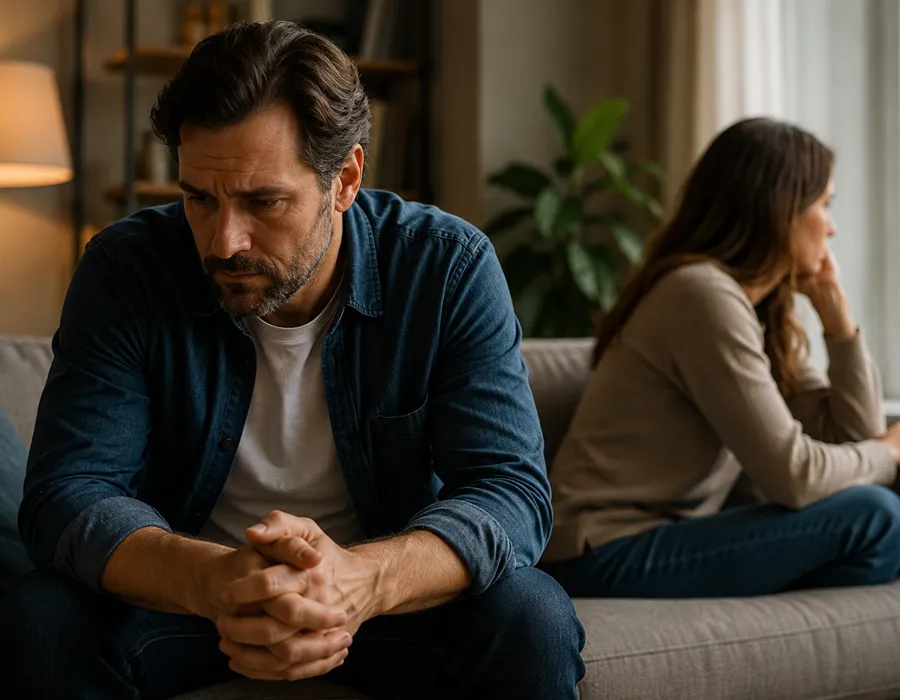
Conversations about feelings seem to go nowhere. When conflict arises, he may become quiet, distant, defensive, or focused on solving the problem rather than talking about how he feels. Attempts to become closer can sometimes seem to make him pull even further away.
For the other partner, this can be deeply lonely.
For the man who has become emotionally walled off, however, the experience may be very different. He may care deeply about the relationship but struggle to identify, express, or safely share what is happening inside him.
At Inner Transformation Therapy, Chris Peknic, LCSW works with individuals and couples to understand the deeper emotional patterns that create distance in relationships. With more than 30 years of clinical experience, Chris helps clients move beyond surface-level conflict and explore what may be happening underneath it.
What Does It Mean to Be Emotionally Walled Off?
An emotionally walled-off man is not necessarily someone who lacks feelings.
In many cases, the opposite may be true.
There can be a rich emotional life beneath the surface, but accessing or expressing those emotions may feel unfamiliar, uncomfortable, or unsafe.
Emotional walls can appear in many ways:
- Shutting down during difficult conversations
- Avoiding vulnerability
- Struggling to name or communicate feelings
- Becoming defensive when a partner expresses emotional needs
- Withdrawing during conflict
- Using work, hobbies, screens, or other distractions to avoid uncomfortable emotions
- Trying to “fix” a partner’s feelings instead of listening to them
- Rarely asking for emotional support
- Appearing detached when emotions become intense
- Having difficulty expressing affection, fear, sadness, or uncertainty
These behaviors can easily be interpreted as indifference. But emotional withdrawal and lack of love are not necessarily the same thing.
Understanding that distinction can be an important first step.
Why Do Some Men Become Emotionally Unavailable?
Emotional walls rarely appear overnight.
They are often built slowly through years of experiences, relationships, family dynamics, cultural expectations, disappointments, or emotional pain.
Some men grow up receiving direct or indirect messages that vulnerability is weakness. They learn to be independent, capable, controlled, and strong—but receive far less guidance about identifying emotions, communicating needs, asking for help, or staying present when another person is distressed.
A boy who learns that sadness should be hidden may become a man who struggles to express grief.
A boy who learns that fear should never be shown may become a man who responds to vulnerability with anger or withdrawal.
Someone who experienced criticism, rejection, abandonment, family conflict, or trauma may learn that emotional distance feels safer than emotional openness.
What once served as protection can eventually become a barrier to intimacy.
When Protection Becomes Disconnection
Emotional walls can work remarkably well at protecting us from uncomfortable feelings.
Unfortunately, they can also keep out the very things we want most: closeness, understanding, trust, affection, and connection.
This can create a painful relationship cycle.
One partner senses distance and reaches for more connection. The emotionally withdrawn partner experiences that pursuit as pressure and retreats. The first partner then feels even more rejected and tries harder to reconnect.
One person pursues.
The other withdraws.
Both become frustrated.
And beneath the frustration, both may actually be longing for the same thing: to feel safe and connected.
Without understanding the deeper pattern, couples can repeat this cycle for years.
Emotional Unavailability Can Affect Both Partners
Living with emotional distance can become exhausting.
The more emotionally expressive partner may begin thinking:
“Why won’t he talk to me?”
“Does he even care?”
“Why do I have to initiate every meaningful conversation?”
“Why do I feel alone when we’re sitting in the same room?”
Meanwhile, the emotionally walled-off partner may be thinking:
“Nothing I say is right.”
“I don’t know what you want me to say.”
“Why can’t we just move on?”
“I feel like I’m constantly failing.”
Both partners can end up feeling misunderstood.
The problem is no longer simply what they are arguing about. It becomes the emotional pattern surrounding the argument.
The Difference Between Emotional Intimacy and Problem-Solving
Many men become highly skilled problem-solvers.
That can be tremendously valuable in life—but emotional intimacy sometimes requires something different.
Imagine a partner saying:
“I had a terrible day. I feel completely overwhelmed.”
A problem-solving response might be:
“Why don’t you talk to your boss?”
An emotionally connected response might begin with:
“That sounds really difficult. Tell me what happened.”
The goal is not always to solve the emotion.
Sometimes the goal is to stay present with the person experiencing it.
Learning this distinction can transform communication between partners.
Vulnerability Is a Relationship Skill
Vulnerability is sometimes misunderstood as simply revealing everything you feel.
Healthy vulnerability is more intentional.
It means becoming capable of recognizing what is happening internally and communicating it honestly while remaining connected to another person.
Instead of:
“Leave me alone.”
A person might eventually learn to say:
“I’m overwhelmed right now, and I can feel myself shutting down. I need a little time, but I don’t want to disconnect from you.”
Instead of anger masking fear:
“This conversation scares me because I’m afraid of losing you.”
Instead of defensiveness:
“What you said hurt, and I’m having trouble talking about it.”
These changes may sound small.
Within a relationship, they can be profound.
How Therapy Can Help Emotionally Walled-Off Men
Therapy provides a space to become curious about emotional walls rather than simply judging them.
The question shifts from:
“What’s wrong with me?”
to:
“What taught me that I needed this wall?”
That question can open the door to deeper work.
At Inner Transformation Therapy, the goal is not to force someone to become more emotional or transform their personality. Instead, therapy can help individuals understand their patterns, recognize emotions more clearly, explore unresolved experiences, and develop healthier ways of connecting.
Chris integrates approaches including relationship and emotional communication work, mindfulness-based therapy, EMDR for trauma, Jungian and depth psychology, grief work, and archetypal and pattern analysis according to each client’s individual needs.
The work may involve exploring:
- Childhood and family relationship patterns
- Fear of vulnerability or rejection
- Past relationship wounds
- Trauma and unresolved emotional experiences
- Anger and defensiveness
- Difficulty identifying feelings
- Communication patterns
- Trust and intimacy
- Emotional regulation
- The beliefs a person developed about what it means to be a man
The purpose is not blame.
It is understanding.
Because when we understand why a protective pattern developed, we have a better opportunity to decide whether we still need it.
How Couples Therapy Can Help Rebuild Emotional Intimacy
When emotional withdrawal has become part of a relationship, couples therapy can help both partners understand the cycle they’re caught in.
Rather than identifying one person as “the problem,” couples can begin recognizing the pattern as the problem.
One partner can learn how to express emotional needs without escalating pursuit or criticism.
The other can learn how to remain present without immediately withdrawing, defending, or shutting down.
Over time, couples can develop new ways to communicate:
More curiosity. Less defensiveness.
More honesty. Less avoidance.
More listening. Less fixing.
More vulnerability. Less protection.
The objective isn’t a relationship without conflict. Healthy couples disagree.
The deeper goal is creating a relationship where both people can remain emotionally connected even when difficult feelings arise.
Can an Emotionally Unavailable Man Change?
People can develop greater emotional awareness and healthier relationship skills, but meaningful change generally requires willingness.
A partner cannot force another person into vulnerability.
What an individual can do is become curious about the walls they’ve built, understand what those walls have been protecting, and gradually practice new ways of connecting.
That process can take courage.
For someone who has spent decades keeping difficult emotions contained, opening up may initially feel uncomfortable rather than liberating.
Change often begins with something very small:
Recognizing an emotion.
Naming it.
Staying present a little longer.
Allowing another person to see it.
And discovering that vulnerability does not always lead to rejection.
Sometimes it leads to connection.
Finding Your Way Back to Each Other
Emotional walls are often built for a reason.
But the strategies that once protected us can eventually prevent us from experiencing the relationships we deeply want.
If emotional distance, communication difficulties, unresolved trauma, or recurring relationship patterns are creating disconnection in your life, therapy can provide a safe place to understand what’s happening beneath the surface.
Chris Peknic, LCSW is a clinical psychotherapist with more than 30 years of experience working with individuals and couples. Inner Transformation Therapy provides in-person therapy in Bristol, Rhode Island, along with virtual sessions for clients throughout Rhode Island.
The goal isn’t simply to communicate more.
It’s to understand yourself and your partner more deeply—and create the emotional safety that makes genuine intimacy possible.
Begin the Conversation
If you or your relationship feels emotionally stuck, you don’t have to figure out the next step alone.
Schedule a free 20-minute consultation with Inner Transformation Therapy to talk with Chris about what you’re experiencing and whether working together may be a good fit.